01Freelance developer vs agency vs in-house: the real question
The freelance developer vs agency vs in-house debate is usually framed as a question of cost. It is really a question of risk, control and time horizon. Who carries the risk if a person leaves? How close are you to the people building the product? And will you still need them in three years?
I have seen all three from the inside. I have worked in-house at product companies, delivered client projects inside development firms, and freelanced directly for clients. Each model has failure modes the others do not. This article is part of my broader guide to hiring a full stack developer; here I go deep on the choice of model.
02Hiring a freelance developer: strengths and trade-offs
With a freelancer you talk directly to the person writing the code. Questions get answered in hours, not in the next status meeting, and the person estimating the work is the person doing it. Overhead is low because you are not paying for an office, account managers or a sales team.
The trade-offs are capacity and continuity. One person has a finite number of hours, and if they are unavailable, work stops. Freelancers also vary enormously in quality, so the burden of vetting sits with you.
A good freelancer often behaves more like a technical partner than a supplier. Because their reputation rests on the product working, the better ones will push back on scope, suggest cheaper ways to test an idea, and tell you when a feature is not worth building yet. That candour is harder to get through an agency account manager.
- Best for: MVPs, internal tools, a defined module, early-stage products.
- Strengths: direct communication, lower overhead, flexibility, often deep ownership.
- Risks: single point of failure, limited parallel capacity, uneven quality across the market.
- Mitigation: your own repository and hosting, documentation, and a clear handover clause.
03Hiring a development agency: strengths and trade-offs
An agency sells a team and a process. You typically get design, development, QA and project management under one contract, and someone who is contractually responsible for replacing a developer who leaves. For a non-technical founder who needs a complete product designed and built, that structure is genuinely valuable.
The trade-offs are cost and distance. Agency rates carry the overhead of the whole business, and the developer actually writing your code may change during the project. Communication often flows through an account manager, which adds a layer between your intent and the code.
- Best for: complete products needing design and QA, fixed deadlines, larger budgets.
- Strengths: a full team, replaceable people, established process.
- Risks: higher cost, less direct contact, junior developers on senior-priced contracts.
- Mitigation: ask who will actually work on your project and meet them before signing.
04Building an in-house development team: strengths and trade-offs
An in-house developer accumulates context that nobody outside can match. They understand your customers, sit in your planning meetings and care about the product over years. When software is your core product, that long-term ownership is hard to replace.
The costs are time and commitment. Recruiting a good developer can take months, and salary, benefits, equipment and management cost continue whether or not there is a clear roadmap. A single in-house hire also has the same single-point-of-failure problem as a freelancer, just with higher fixed costs.
There is also a management question. An in-house developer needs someone to set priorities, review their work and support their growth. If nobody in the company can do that yet, a first in-house hire often ends up isolated, which is a poor experience for them and a risky one for you.
- Best for: software that is the business, long-term roadmaps, sensitive domains.
- Strengths: deep context, long-term ownership, cultural alignment.
- Risks: slow and costly to hire, fixed cost regardless of workload, hard to scale down.
- Mitigation: hire a senior first, and use contractors around them for peaks.
05Cost, speed and control compared side by side
On cost, a freelancer is usually cheapest per hour of output, an agency most expensive, and in-house somewhere between — but only if the in-house person is fully utilised. On speed to start, a freelancer can often begin within days, an agency within a couple of weeks, and an in-house hire may take months.
On control and context, in-house wins over time, a good freelancer is close behind because you work directly with them, and agencies are furthest away. For a fuller look at rates and hidden costs in each model, see my breakdown of what a full stack developer costs in 2026.
- Time to start: freelancer fastest, agency next, in-house slowest.
- Cost per hour of output: freelancer lowest, agency highest.
- Fixed commitment: in-house highest, freelancer lowest.
- Continuity if someone leaves: agency strongest, freelancer and solo in-house weakest.
- Product context over years: in-house strongest.
06A decision framework for choosing the right model
Work through these questions in order. The first one that gives a clear answer usually decides it.
- Is the software your core product, and will you be building it for years with steady work? Lean in-house, possibly starting with a contractor.
- Do you need design, development and QA delivered as a package against a fixed deadline, with budget to match? Lean agency.
- Is it an MVP, an internal tool or a defined module that one accountable person could own? Lean freelancer.
- Do you have someone technical who can review work? If not, choose a freelancer who documents and communicates well, or an agency with a strong project manager.
- Is the budget tight and the scope still uncertain? A freelancer on short milestones keeps your options open.
You do not have to choose forever. A common and healthy path is a freelancer to build and validate the product, then an in-house hire who takes over a well-documented codebase.
07Hybrid models: combining freelancers, agencies and in-house developers
In practice the cleanest answer is often a mix. The three models are not mutually exclusive, and most growing companies end up using more than one at the same time.
One pattern I see work well is an in-house technical lead who owns the architecture and the roadmap, with freelancers taking on well-defined modules such as a reporting area, an integration or a mobile companion app. The lead keeps the context; the freelancers add capacity without permanent headcount.
Another is an agency for the initial design and brand, then a freelance full stack developer for the build and ongoing development. That gives you a polished design system without paying agency rates for every month of iteration that follows. The reverse also happens: a freelancer builds and validates the product, and an agency or in-house team scales it once the business case is proven.
What makes any hybrid work is a single owner of the technical direction and a codebase that is documented well enough for people to join and leave. Without that, a mix of providers becomes a mix of styles, conventions and half-finished decisions.
- In-house lead plus freelancers for defined modules.
- Agency for design, freelancer for build and iteration.
- Freelancer to validate, then in-house team to scale.
- Always: one technical owner and documentation as a deliverable.
08How to hire well whichever model you choose
The vetting principles are the same across all three. Look at shipped work, ask how they would approach your first milestone, and check whether they ask about your users before your stack. My list of questions to ask before hiring a developer works for freelancers, agencies and in-house candidates alike.
Whatever the model, keep ownership on your side: your repository, your hosting account, your domain, and documentation as a deliverable. That single habit makes every future transition — freelancer to in-house, agency to freelancer — far cheaper.
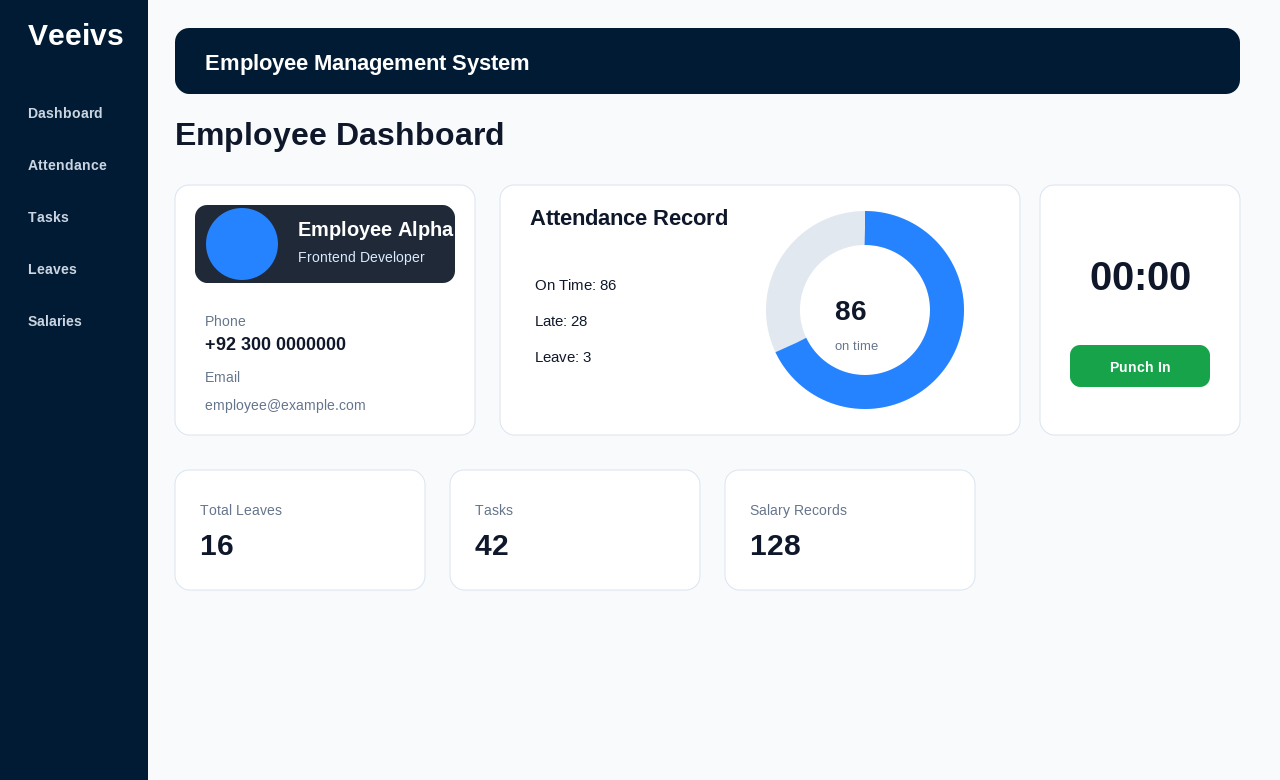
If the freelance route fits your project, my custom software development service covers how I take on new builds, and the EMS employee management platform is an example of a system I owned across UI, backend and permissions.