01Why the questions you ask before hiring a developer matter
Most hiring mistakes are visible in the first conversation if you ask the right questions. The problem is that most clients ask about technologies — do you know React, have you used Stripe — and almost every developer can say yes to those. The questions to ask before hiring a developer are the ones that reveal judgement, honesty and communication.
I have been on the receiving end of many of these conversations as a freelance developer, and the clients who asked the hardest questions were consistently the best to work with. This article is part of my complete guide to hiring a freelance full stack developer.
02Questions about past work and experience
Start with something they have actually shipped. You are not checking the result so much as how they talk about it.
- Walk me through a project you built end to end. What did the data model look like?
- What went wrong on that project, and what would you do differently?
- Which part of that system was hardest, and why?
- Can I see it live, or a detailed case study of it?
- Have you built something with similar users, roles or integrations to mine?
A good answer names a specific mistake and what they learned. “Nothing went wrong” is the weakest possible answer — it means either they were not paying attention or they are not being straight with you.
03Questions about how they would approach your project
Describe your project briefly, then ask how they would start. This is the most revealing part of the conversation, because it shows whether they understand the problem before proposing a solution.
A good developer asks questions back: who the users are, which workflow matters most, how much data there is, which integrations are essential, what already exists. A weak one starts naming frameworks within a minute.
- What would you build first, and what would you leave out of the first release?
- What do you see as the riskiest part of this project?
- What would you need from me to get started?
- How would you structure the first milestone, and how long would it take?
04Questions about process, communication and scope changes
Technical skill gets a project started; process and communication get it finished. Ask how the week actually works.
- How often will I get updates, and in what form?
- Will I be able to see work in progress on a staging site?
- What happens when I want to change something mid-milestone?
- How do you estimate, and what do you do when an estimate turns out wrong?
- What hours are you available, and how quickly do you usually respond?
Listen for a concrete rhythm — written updates on set days, a weekly demo, a shared board — rather than “I will keep you posted”. Vague process now becomes silence later. If the developer is remote, my notes on working with a remote developer across time zones cover what a good cadence looks like.
05Questions about code quality, ownership and what happens after launch
These questions protect you from the most expensive outcomes: being locked out of your own product, or inheriting code nobody else can maintain.
- Will the code live in a repository I own from day one?
- Who owns the intellectual property, and when does it transfer?
- How do you test your work, and what do you test?
- How do you handle backups, secrets and access control?
- What documentation will I get, and could another developer take over?
- What support do you offer after launch, and how is it priced?
The right answer to ownership is simple: your repository, your hosting account, your domain, and IP assigned to you on payment. Any hesitation here is a serious red flag.
06How to run a paid trial task
For anything larger than a few weeks of work, a small paid trial is the best investment you can make in a hire. It shows you code quality, communication, reliability and how they handle ambiguity, all in one go, and it costs a fraction of a bad hire.
Pay for it at their normal rate. Unpaid tests filter out exactly the experienced developers who have other options. Keep it small — a few days at most — and make it real: a genuine slice of your product rather than a puzzle.
If you are not technical, ask a trusted technical friend or advisor to review the code with you. Even an hour of their time is enough to spot obvious problems such as passwords in the code, no structure, or no attempt at validation.
- Pick a self-contained feature, for example one form with validation, an API endpoint and a list view.
- Write a short brief with acceptance criteria, and leave one detail deliberately open.
- Ask for the work in a repository you own, deployed somewhere you can click.
- Judge the questions they ask, the update they send, and the code — not just whether it works.
- Review it with them on a call and ask what they would improve with more time.
The deliberately open detail is the most useful part. Does the developer ask about it, make a sensible assumption and tell you, or silently guess? That is exactly how they will behave on the real project.
07Good answers, weak answers and red flags
It helps to hear the difference. Here are a few of the questions above with the kind of answer that should reassure you and the kind that should not.
Ask “what is the riskiest part of this project?” A weak answer is “nothing, it is straightforward”. A good answer is specific: “the import from your old spreadsheets, because the phone numbers are in four formats and some customers appear twice — I would want to see a sample before estimating that”. The second developer has already started doing the job.
Ask “what happens if I change my mind mid-milestone?” A weak answer is either “no problem, anything you want”, which means scope will drift with no accounting, or “changes cost extra”, with no process. A good answer describes a process: small changes are absorbed, larger ones are written up, estimated and either swapped for something else in the milestone or moved to the next one.
Ask “how do you test your work?” A weak answer is “I test everything manually before delivery”. A good one distinguishes between what gets automated tests — business rules, calculations, permissions — and what gets checked by hand, and explains why. Honesty about trade-offs is a better sign than a claim of perfect coverage.
Across the whole conversation, these are the red flags to note. Most are not dealbreakers individually; two or three together usually are.
- Quotes a fixed price for a large project without asking questions.
- Agrees with everything you say and never pushes back on scope.
- Cannot explain past work beyond screenshots.
- Wants to host the code and infrastructure on their own accounts.
- Blames previous clients or developers for every past problem.
- Has no answer on testing, security or maintenance.
- Promises a timeline that seems too good to be true — because it is.
The pattern behind every good answer is the same: specific, honest about trade-offs, and grounded in something they have actually done. Rehearsed generalities are the warning sign.
08Putting it together: a short vetting checklist
Combine these into one process: a first call about past work and your project, a written proposal for the first milestone, a paid trial for larger projects, and a reference or live product check. That sequence takes a week or two and removes most of the risk.
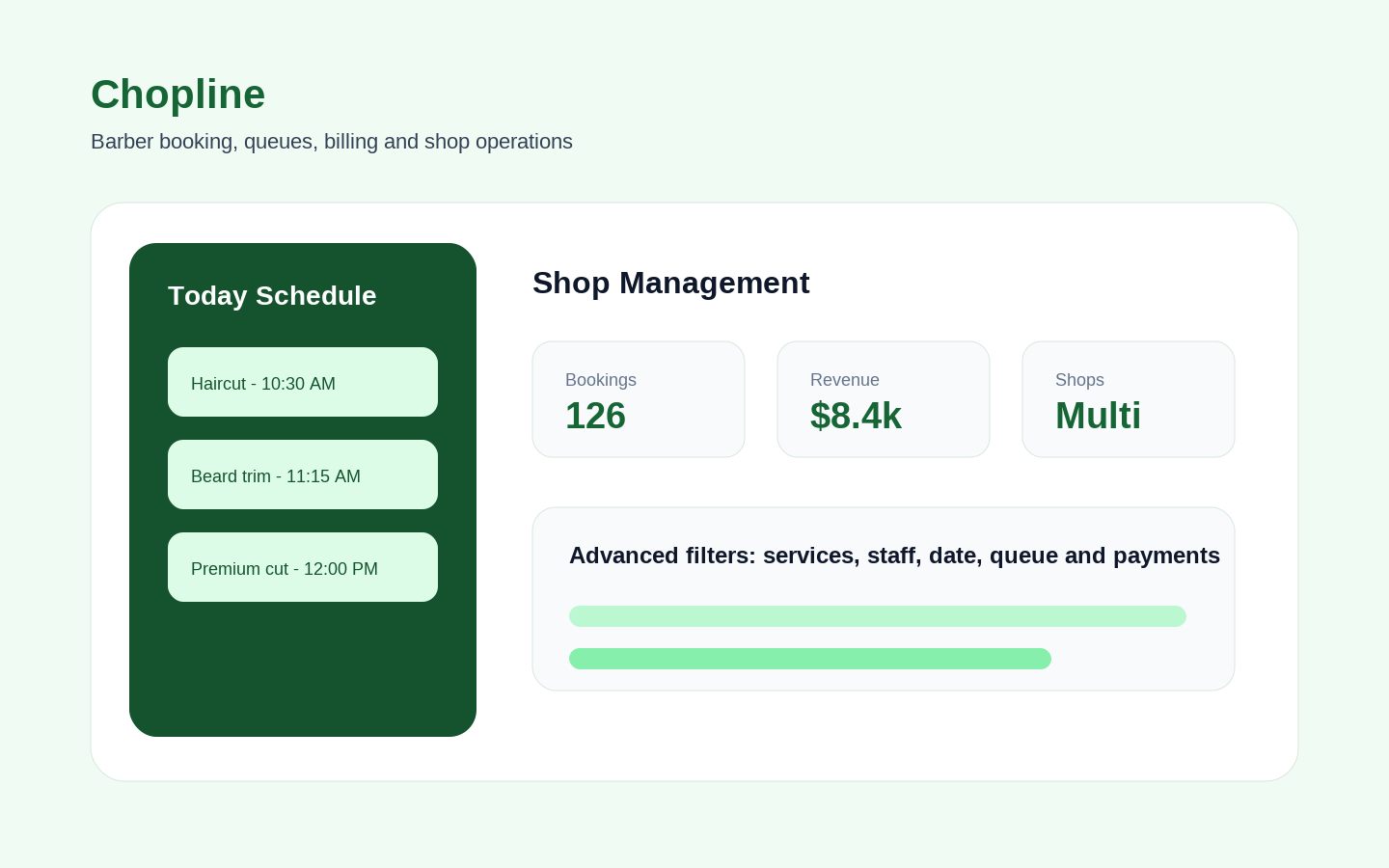
The same questions apply whether you are choosing between individuals or deciding between a freelance developer, an agency or an in-house team. If you would like to put these questions to me directly, my full stack development service explains how I work, and the Chopline barber booking SaaS is a good example of a product I can walk you through in detail.